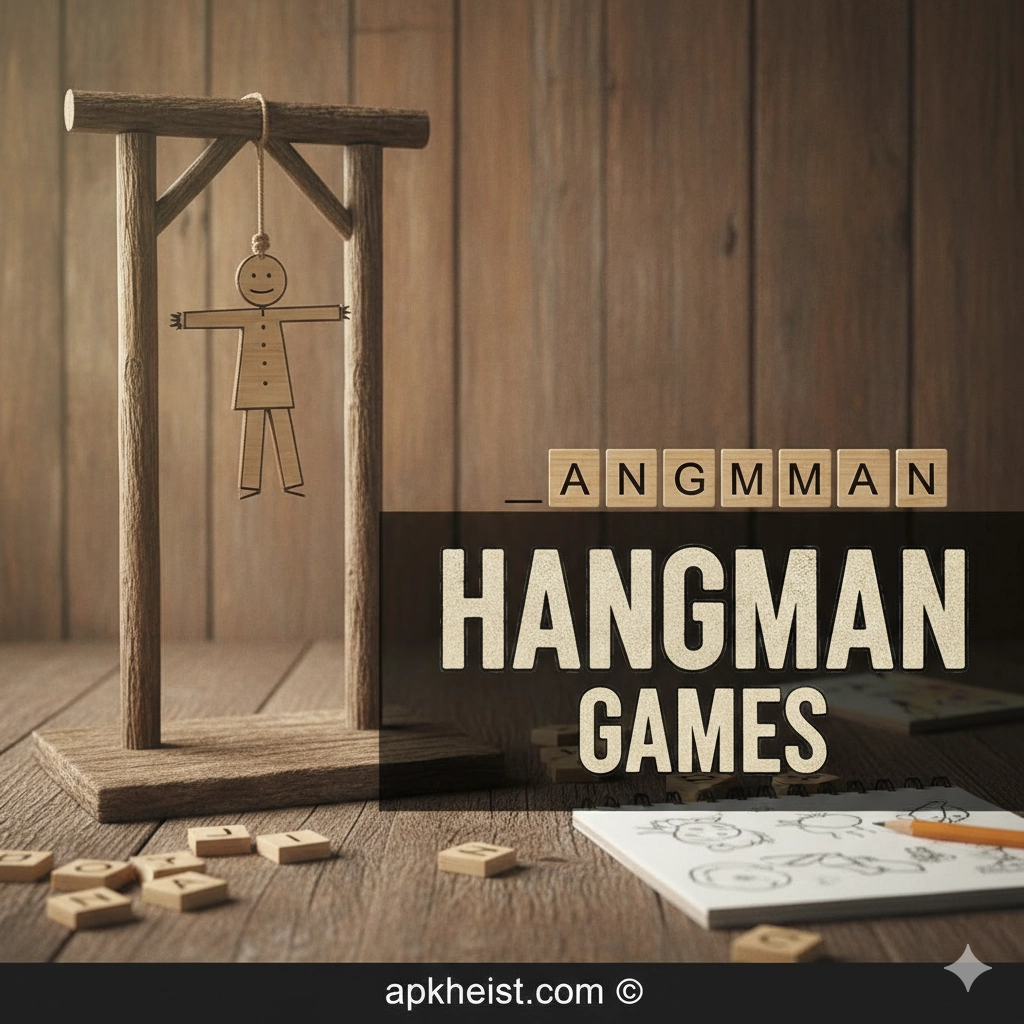
From classroom chalkboards to modern mobile platforms, Hangman Games have evolved into digital experiences that blend entertainment and education. Whether played casually at home or competitively online, the objective remains the same: guess the hidden word before the drawing is complete. Today, many word enthusiasts who also enjoy titles like Guess The Pictures Games: The Ultimate or logic-driven experiences such as Brainstorm Test: Tricky Puzzle Games often find Hangman equally stimulating. Its adaptability across Puzzle and Word categories ensures it continues to attract new generations of players.
Table of Contents
1. The Core Mechanics of Hangman Games – Understanding the foundational gameplay loop.
2. Educational Benefits and Cognitive Development – How Hangman strengthens language skills.
3. Digital Evolution of Hangman – From paper to mobile apps.
4. Strategies to Improve Your Win Rate – Advanced guessing techniques.
5. Variations and Modern Game Modes – Creative twists on the classic format.
6. Why Hangman Games Remain Popular Today – Longevity in a competitive gaming market.
1. The Core Mechanics of Hangman Games
At its core, Hangman Games operate on a straightforward deduction model. A hidden word is represented by blank spaces corresponding to each letter. Players guess letters sequentially. Correct guesses reveal positions within the word, while incorrect guesses contribute to the gradual drawing of the hangman figure.
This risk-reward structure introduces tension and decision-making. Players must balance frequency-based guessing (such as vowels and common consonants) with contextual reasoning. The simplicity of the rules allows accessibility across age groups, while the variability of word selection ensures replayability.
2. Educational Benefits and Cognitive Development
Hangman Games are widely used in educational settings because they promote vocabulary expansion, spelling accuracy, and pattern recognition. Teachers frequently integrate them into language learning curricula to encourage participation and reinforce retention.
By analyzing letter frequency and structural cues, players unconsciously develop probabilistic thinking. This overlaps with cognitive skills seen in other educational titles like 5th Grader Quiz: Are You Smart Games, where reasoning and recall are equally critical.

3. Digital Evolution of Hangman
Originally a pen-and-paper pastime, Hangman has successfully transitioned into the digital era. Mobile applications now incorporate categories, timed rounds, multiplayer modes, and global leaderboards. Some versions even integrate visual and thematic storytelling elements similar to experiences found in VSMILES Games: The Complete Guide to.
Gamification features such as achievements, daily challenges, and adaptive difficulty have modernized the format without altering its fundamental mechanics.
4. Strategies to Improve Your Win Rate
Advanced players approach Hangman Games strategically rather than randomly. A strong opening typically includes high-frequency vowels (E, A, O) followed by common consonants (R, T, N, S). Observing word length and identifying common suffixes such as “-ING” or “-TION” can significantly improve deduction efficiency.
Additionally, recognizing thematic categories—such as animals, geography, or pop culture—can narrow possible word sets. Strategic elimination reduces cognitive load and increases success probability.
5. Variations and Modern Game Modes
Contemporary Hangman Games feature multiple variations: multiplayer battles, survival modes, time-attack challenges, and customizable word banks. Some integrate competitive elements seen in broader Trivia ecosystems, while others merge storytelling components similar to Adventure games.
These innovations ensure that Hangman remains adaptable to evolving player expectations without sacrificing its minimalist identity.
6. Why Hangman Games Remain Popular Today
The sustained popularity of Hangman Games can be attributed to three factors: simplicity, educational value, and universal accessibility. Unlike graphically intensive genres such as Action or Simulation, Hangman requires minimal technical resources while delivering consistent engagement.
Its cross-generational appeal makes it suitable for classrooms, families, and casual gamers alike. In a market saturated with complex mechanics, Hangman stands out through elegant design and intellectual challenge.
Frequently Asked Questions About Hangman Games
FAQ 1: Are Hangman Games suitable for children?
Yes. Hangman Games are highly adaptable for children. Word difficulty can be adjusted to match age and skill level, making them effective for both early literacy and advanced vocabulary development.
FAQ 2: Can Hangman Games improve vocabulary?
Absolutely. Repeated exposure to new words reinforces spelling patterns and word recognition. Over time, players internalize language structures and expand their lexical knowledge.
FAQ 3: Are there multiplayer Hangman options?
Yes. Many digital versions offer local and online multiplayer modes, allowing friends or global competitors to participate in real-time guessing challenges.
FAQ 4: What makes Hangman Games different from other word puzzles?
The elimination mechanic. Unlike crossword or word search formats, Hangman introduces progressive penalty visualization, increasing psychological tension with each incorrect guess.
FAQ 5: Do Hangman Games require internet access?
Not necessarily. Many versions can be played offline, especially basic mobile adaptations, making them convenient for travel or classroom environments.
Conclusion: Hangman Games demonstrate how minimalist design, strategic reasoning, and educational utility can coexist within a single framework. Their longevity proves that compelling gameplay does not require complexity—only intelligent structure and engaging challenge.