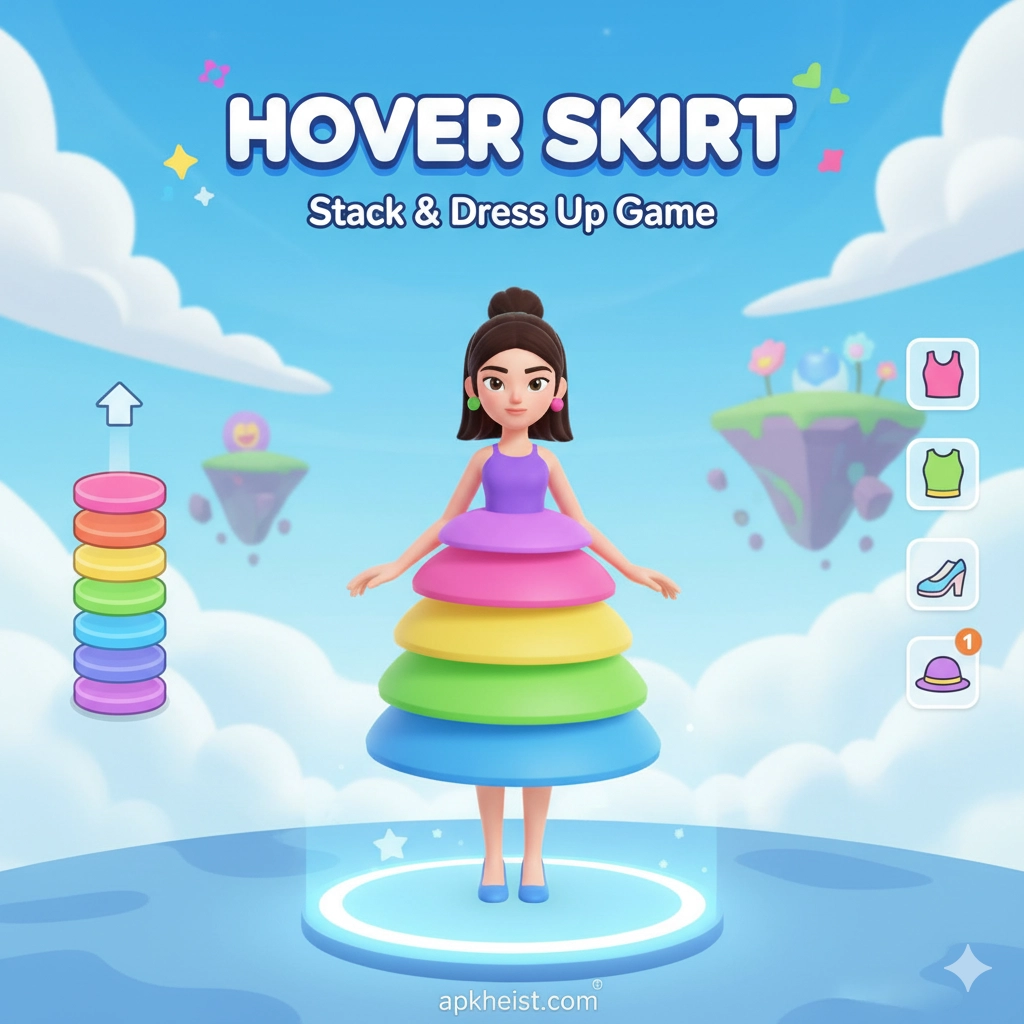
Long intro: Hover Skirt: Stack & Dress Up merges arcade-style stacking with fashion-driven progression. Each round challenges the player to align and stack hovering skirt segments while managing momentum, timing, and occasional in-game modifiers. Beyond core mechanics, the title offers deep customization — fabrics, patterns, accessories — and meta-progression systems such as unlockable themes, seasonal events, and social sharing. Success in Hover Skirt requires both mechanical consistency and an eye for composition: mastering the physics of stacking earns high scores; curating outfits earns badges, rewards, and community recognition. The following sections break down gameplay systems, strategies, customization tips, and troubleshooting advice to help players of all levels perform better and enjoy the game more deeply.
1. Core Mechanics — How Stacking Works — A concise overview of the stacking physics, controls, and scoring rules.
2. Controls & Input Tips — Practical control advice for touch and mouse players to improve consistency.
3. Customization & Wardrobe Progression — How fabrics, patterns, and accessories unlock and affect your style score.
4. Scoring, Combos & Multipliers — Detailed breakdown of score formulas, combo triggers, and multiplier management.
5. Event Modes & Seasonal Challenges — Overview of temporary modes, themed challenges, and reward structures.
6. Common Problems & Troubleshooting — Solutions to common issues: input lag, mismatched visuals, and save failures.
7. Community, Sharing & Competitive Play — Best practices for sharing replays, entering competitions, and collaborating with other players.
RealmCraft Game: A Complete Exploratio
Zombie Waves Game: Survive the Night
1. Core Mechanics — How Stacking Works
At its core, Hover Skirt: Stack & Dress Up is a timing-and-alignment game. Each skirt segment approaches a base plane on a horizontal axis; the player's objective is to place the moving segment as centrally aligned as possible. The game employs a simple but precise physics model: when a segment is placed off-center, the excess portion is trimmed and removed, reducing available surface area for future segments and increasing the difficulty of subsequent placements. Perfect alignments yield bonus rings, maintain maximum surface, and build combo counters. Over time, the game introduces modifiers — wind gusts, shrink pulses, and speed ramps — which alter the approach speed or orientation of segments. Understanding these modifiers and their predictable cycles is essential to sustained high-score runs. Additionally, some modes introduce elastic surfaces where slight offsets create restoring forces; mastering the restoration timing can transform otherwise marginal stacks into stable, high-scoring towers.
The scoring algorithm rewards both precision and risk-taking. Complete center placements produce small, frequent score increments; risky overhang placements with successful corrective landings produce larger one-off bonuses. Seasonal levels may add aesthetic multipliers (for example, matching a skirt's pattern to a level's theme grants an aesthetic multiplier). Players aiming for leaderboard placement should focus on two simultaneous objectives: maintain a wide, stable base through precise early placements, then deliberately perform high-risk alignments under controlled conditions to trigger combo bursts.
2. Controls & Input Tips
Hover Skirt supports both touch and mouse input. The fundamental action is a single-tap or click to drop the moving segment. For touch players, tap timing and surface area perception are paramount; practice sessions using the game's slower-speed training mode can ingrain the cadence required for consistent placements. For mouse players, consider assigning a comfortable keybind or using the left mouse button with light, consistent pressure. Input lag can be deceptive: if you feel a delay between your action and the response, check background processes, lower graphical settings, or enable the game's low-latency input mode (if available). Many advanced players recommend using a short, focused warm-up — 20 to 30 practice drops — before attempting leaderboard runs to recalibrate muscle memory for the current session.
Another practical tip is to adopt a micro-adjustment habit: when a segment approaches slightly faster due to an in-game speed modifier, avoid full-tap reflexes and instead micro-time your taps to the segment's leading edge. This subtle shift in timing reduces trimming frequency and preserves surface area. Finally, use saved replays to analyze input windows; the game’s built-in replay scrubber is an invaluable tool for identifying consistent timing errors and correcting them methodically.

3. Customization & Wardrobe Progression
Customization is more than cosmetic: it is a progression loop designed to reward playtime and provide strategic variety. Players unlock new skirts, fabrics, and accessories by earning currency through scores, completing wardrobe challenges, and participating in event modes. Each garment has an aesthetic score component and sometimes a passive gameplay modifier — for example, certain skirts may slightly reduce wind effects, while others increase combo multipliers for perfectly centered placements. Wardrobe progression therefore affects both form and function.
When building a wardrobe strategy, balance the desire for visual cohesion with functional benefits. For example, if you struggle with wind modifiers, prioritize outfits with wind-resistance traits early in your progression. Conversely, if you have mastered timing but need score optimization, prioritize items that boost aesthetic multipliers or combo durations. The game also often includes limited-time sets (holiday or collaboration themes) that provide unique cosmetic options and temporary stat bonuses; players should prioritize these when they align with personal playstyle goals. Sharing outfits on community channels fosters social feedback and can yield ideas for combinations you might not have considered.
4. Scoring, Combos & Multipliers
Scoring in Hover Skirt uses a layered system: base points per placement, combo multipliers for consecutive near-perfect placements, and aesthetic multipliers for outfit-level matches with level themes. Combos are tracked in a visible meter; sustaining the meter through consecutive precise drops increases the per-segment value exponentially. A common advanced tactic is the "staggered-risk" — deliberately performing two moderate-risk placements followed by a high-precision placement to convert trimmed surface into a combo burst.
Understanding when to cash in a combo is critical. Some players prefer to maintain long combos for steady gains, while others accumulate situationally — building a combo until a high-value modifier appears and then maximizing the payout. Keep an eye on the multiplier cap for each mode; some event modes raise the cap temporarily, creating windows of amplified scoring potential. Effective score leaders synchronize outfit aesthetic bonuses with multiplier windows, which results in disproportionately large point gains compared to non-synergized runs.
5. Event Modes & Seasonal Challenges
Event modes expand the core loop by introducing time-limited mechanics, unique scoring rules, and themed rewards. Examples include "Neon Night," where glow patterns on skirts create matching requirements, and "Gale Rush," where persistent wind gusts alter segment trajectories. Seasonal challenges typically provide tiered rewards — basic participation rewards, performance thresholds, and top-tier leaderboard prizes. Participation consistency is often more valuable than single-run spikes: completing daily event objectives steadily accumulates currencies and rare cosmetics.
Preparation for events involves two steps: first, adapt your wardrobe to the event’s mechanical demands (e.g., wind-resistant skirts for gale-themed events); second, study event-unique scoring multipliers and plan run strategies around multiplier windows. Community-run guides and event breakdowns are a reliable source of meta-strategy; players who read them before an event frequently outperform those who rely on ad-hoc adaptation.
6. Common Problems & Troubleshooting
Players encounter several recurring issues. Input lag and frame drops are the most frequent performance complaints; these can often be resolved by closing background applications, switching to a lower graphical preset, or toggling the game's frame-smoothing option. If save files fail to synchronize, verify cloud save settings and internet connectivity; manual export/import features exist for local backups. Visual mismatch errors — where the client displays a different skirt version than the server — are rare but can be addressed by clearing the game's cache and forcing an asset re-download. If you experience unexpected trimming or collision anomalies, report the specific replay to the developers with timestamps; high-quality bug reports accelerate fixes.
A few advanced troubleshooting tips: enable the game's "show hitboxes" debug overlay when practicing in training mode to visualize alignment windows, and use the replay frame-stepper to identify the exact frame where an offset occurs. These diagnostics convert subjective feeling into actionable data, enabling focused corrective practice rather than aimless repetition.
7. Community, Sharing & Competitive Play
Hover Skirt fosters a vibrant community of stylists and stackers. Social features include replay sharing, outfit galleries, and community challenges. For competitive play, the typical loop is: practice in training, refine a run to near-perfection, export a replay, and submit it to weekly leaderboards or community tournaments. Players who document their runs and provide annotated replays both help others and refine their own understanding of subtle mechanic interactions.
When entering community competitions, adhere to event rules carefully; many tournaments disallow certain modifiers or require stock outfits to level the playing field. Networking with other top players often yields cooperative practice sessions where members simulate event conditions and exchange targeted feedback. Over time, these cooperative efforts raise the competency floor for the entire community.
FAQ: What platform is Hover Skirt available on?
Hover Skirt is commonly distributed on mobile storefronts (both major app stores) and sometimes as a lightweight web build. Platform availability will depend on the developer's publishing choices and regional store policies; check the official store page for the most current listing.
FAQ: How do I unlock premium wardrobe items?
Premium items are typically unlocked through in-game currency or special event milestones. Some items may be gated behind seasonal passes or timed challenges. Prioritize daily objectives and event participation to maximize your chances of obtaining premium pieces without direct purchases.
FAQ: Are there accessibility options for players with motor control difficulties?
Yes. Many casual stacking games include accessibility features such as adjustable input sensitivity, auto-assist placements, and extended timing windows. Check the settings menu for assist toggles; enabling assist may reduce leaderboard competitiveness but significantly improves accessibility for recreational play.
FAQ: What should I do if I encounter a bug during a ranked run?
Immediately export the replay and any available logs, then submit them through the game's support channel with a clear description and timestamps. If a rollback or compensation is appropriate, the developers will typically respond after validating the report.
FAQ: How can I improve my stacking consistency quickly?
Focus on short, focused practice sessions with the debug hitbox overlay enabled, analyze replays frame-by-frame to identify timing drift, and warm up before attempting high-stakes runs. Consistency improves fastest when practice is deliberate and informed by objective replay data rather than sheer repetition.