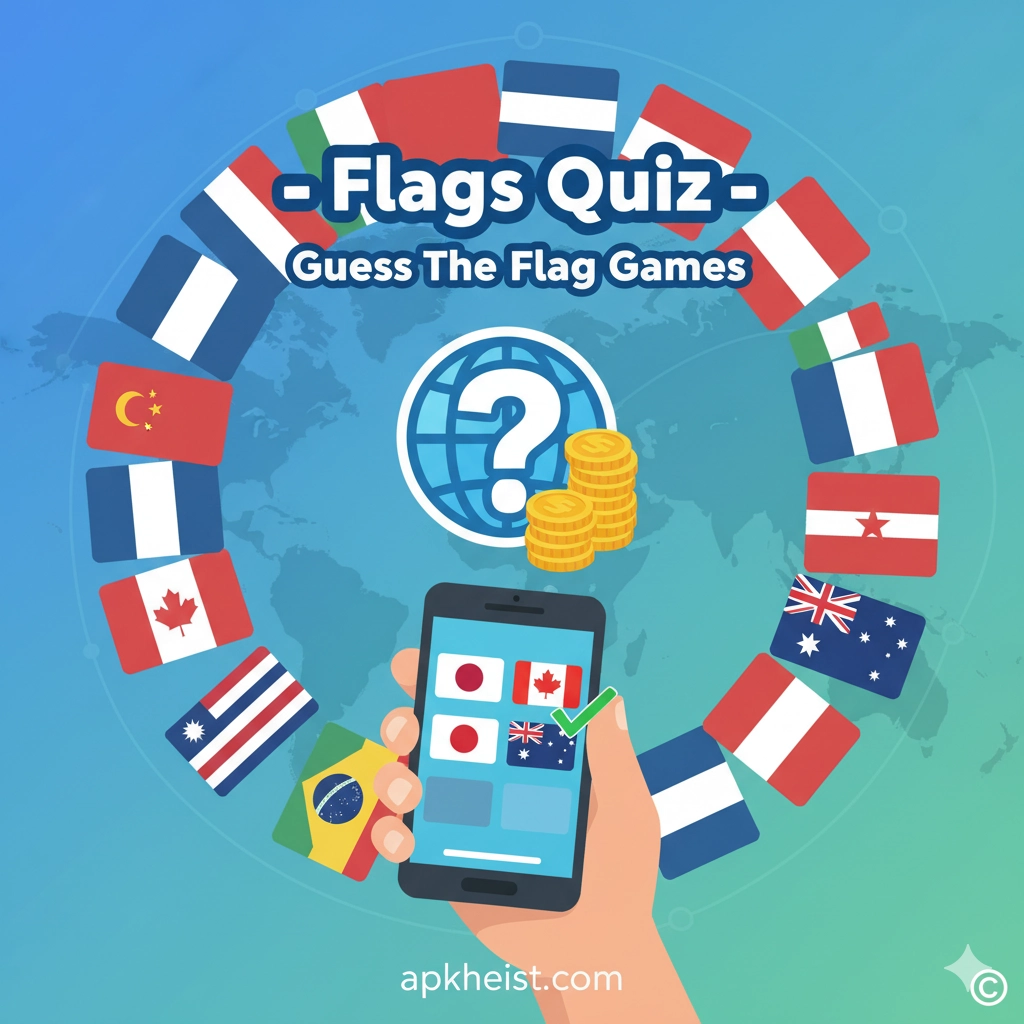
Flags Quiz - Guess The Flag Games combines education and entertainment into a dynamic quiz format designed for players of all ages. Whether you are a student sharpening your geography skills, a traveler preparing for international adventures, or simply someone who enjoys competitive trivia, this game offers a structured progression system, increasing difficulty levels, and rewarding achievements. With hundreds of country flags to memorize, multiple-choice challenges, timed modes, and global leaderboards, the game stimulates cognitive recall, pattern recognition, and cultural awareness. Its intuitive interface ensures smooth gameplay while encouraging long-term retention of geographic knowledge.
Table of Contents
1. Core Gameplay Mechanics – Understanding how the quiz system works.
2. Learning Benefits and Cognitive Development – Educational value explained.
3. Game Modes and Difficulty Levels – Exploring various challenge formats.
4. Visual Design and User Experience – Interface and usability analysis.
5. Competitive Features and Leaderboards – Social and ranking elements.
6. Integration Within the Trivia Genre – Positioning among trivia and educational games.
1. Core Gameplay Mechanics
The primary structure of Flags Quiz - Guess The Flag Games revolves around identifying flags presented on screen. Players are given either multiple-choice answers, letter selection puzzles, or timed rapid-response challenges. The scoring system typically rewards speed and accuracy, creating a balance between quick thinking and careful observation. As players progress, flags become less recognizable, introducing territories and smaller nations to increase difficulty. The gradual complexity ensures sustained engagement while reinforcing memory retention.
Hints, skip options, and reward-based progression mechanics maintain accessibility for beginners. At the same time, advanced players can unlock harder tiers that remove hints or shorten response times. This layered design supports both casual engagement and serious trivia mastery.
2. Learning Benefits and Cognitive Development
Beyond entertainment, Flags Quiz - Guess The Flag Games functions as a micro-learning platform. Repeated exposure to flag imagery enhances visual association skills and strengthens long-term memory encoding. By linking colors, symbols, and patterns with country names, players build geographic literacy efficiently.
This type of quiz format activates recall-based learning rather than passive recognition. Such engagement improves neural connections related to pattern differentiation and symbolic interpretation. For students and competitive quiz participants, consistent gameplay can significantly improve world geography knowledge in a measurable way.
3. Game Modes and Difficulty Levels
Different gameplay modes add structural diversity. Standard mode focuses on progressive unlocking, while timed mode increases pressure for competitive players. Survival mode challenges users to answer continuously without mistakes. Some versions introduce continental filters, allowing players to focus on Europe, Asia, Africa, or the Americas.
These segmented modes allow personalized learning trajectories. Beginners may start with well-known countries, while advanced players tackle obscure territories. The scalable difficulty ensures long-term replayability.

4. Visual Design and User Experience
The user interface emphasizes clarity. Flags are displayed in high resolution with balanced contrast to ensure accurate recognition. Minimalistic menus reduce distraction, keeping attention on the core quiz task. Smooth transitions between questions improve engagement and prevent cognitive fatigue.
The design philosophy aligns well with the broader Trivia category, where clean layouts and rapid interaction cycles are essential. Compared to more action-heavy genres like Action, this game prioritizes cognitive stimulation over reflex-based gameplay.
5. Competitive Features and Leaderboards
Modern implementations of Flags Quiz - Guess The Flag Games often incorporate global leaderboards, achievement badges, and daily challenges. These elements introduce a competitive dimension, encouraging players to improve accuracy rates and reduce response times.
Some editions include multiplayer features where users can challenge friends in real-time sessions. This competitive layer increases retention rates and enhances replay value by adding social interaction to the learning process.
6. Integration Within the Trivia Genre
Within the broader gaming ecosystem, this title fits naturally into both the Educational and Puzzle segments. It shares structural similarities with word-guessing mechanics found in Word games while maintaining the structured scoring system typical of knowledge-based challenges.
The hybrid nature of education and entertainment positions it as a valuable tool for casual learners and competitive trivia enthusiasts alike. Its simplicity ensures accessibility, while its depth supports advanced mastery.
Frequently Asked Questions (FAQ)
1. Is Flags Quiz - Guess The Flag Games suitable for children?
Yes. The game is designed with intuitive controls and progressive difficulty, making it appropriate for children, students, and adults. It promotes geography knowledge in an interactive format.
2. Does the game require an internet connection?
Many versions offer offline gameplay for single-player modes. However, online connectivity may be required for leaderboards and multiplayer challenges.
3. How many country flags are included?
Most comprehensive versions include over 190 internationally recognized countries, along with additional territories to expand the challenge.
4. Are there different difficulty settings?
Yes. Difficulty increases gradually, and some modes allow manual selection of beginner, intermediate, or advanced levels.
5. Can playing improve geography skills?
Consistent gameplay enhances recognition memory and reinforces knowledge of national symbols, making it a practical supplementary learning tool.
6. What genre does this game belong to?
It primarily belongs to the trivia genre, with strong overlaps in educational and puzzle classifications due to its structured question-and-answer format.