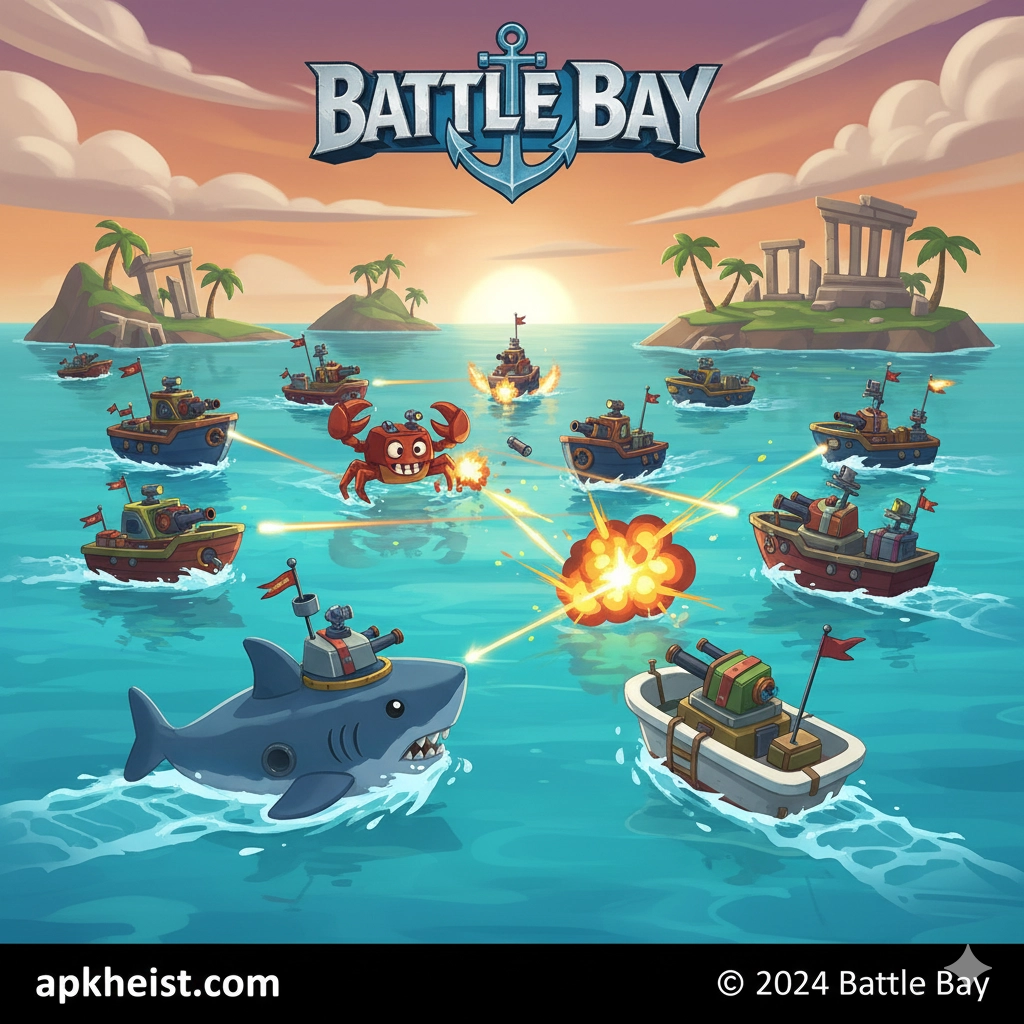
Long intro: In Battle Bay, matches hinge on vehicle choice, weapon loadouts, map awareness, and above all, teamwork. Whether you are a newcomer learning basic controls or an experienced player refining meta strategies, understanding the interaction between boat classes, weapon synergies, upgrade priorities, and role execution will markedly increase your win rate. This article provides a structured walkthrough — from fundamental mechanics to advanced tactics — with practical examples, recommended loadouts, and answers to frequently asked questions. Along the way you will find links to related game guides and genre resources to broaden your tactical perspective, such as LOST in BLUE Game and community strategy hubs like Star Stable Online Game.
Contents (quick links):
1. Fleet Types & Roles — Brief on boat classes and role selection.
2. Controls & Positioning — Movement, aim, and map positioning essentials.
3. Weapon Systems & Upgrades — Choosing weapons and upgrade priorities.
4. Teamplay & Objective Execution — How to coordinate as a five-player unit.
5. Maps & Objective-Specific Tactics — Adapting strategy to map layout.
6. Progression, Economy & Resource Management — Leveling, currencies, and smart spending.
7. Advanced Strategies & Meta — Higher-level techniques and counterplay.
1. Fleet Types & Roles
Battle Bay's fleet composition defines your team's identity before a match begins. Boats fall into recognizable roles: assault (damage dealers), support (heals, speed buffs, utility), tank (high durability, zone-holding), and skirmisher (fast, hit-and-run). Selecting the right boat for your role is a function of map, opponent composition, and team plan. For example, a narrow-map scenario rewards tanks and short-range burst weapons, whereas open-water maps favor long-range skirmishers.
When building your comp, consider complementary abilities: pair area-denial weapons with a tank that can hold the choke point, and pair sustained-fire weapons with supports that extend survivability. Boat choice should also align with crew skill investment—if you have heavily upgraded weapons on a particular boat, bias selections to maximize value. For conceptual expansion on cross-genre tactics, review survival and resource guides such as Dead Rails: Survive Simulator.
2. Controls & Positioning
Mastering controls and positioning differentiates competent players from great ones. Core control principles: maintain optimal firing arcs, use cover to break enemy lock-on, and circle-strafe slower opponents to nullify their aim. Positioning rules of thumb: never overextend without vision, control high-value lanes (choke points / objective approaches), and always have an escape vector. Effective positioning also requires constant mini-map checks and anticipating enemy rotations.
Practice drills: 1) focus-only navigation sessions to master acceleration/braking; 2) aim-only sessions against bots to refine predictive shooting; 3) team drills for synchronized pushes. Combining these practices builds muscle memory for split-second decisions during live matches. If you enjoy reading about complementary multiplayer design, see guides like Egg Wars Game: The Complete Guide to understand how objective pressure translates across genres.
3. Weapon Systems & Upgrades
Weapon selection is the single largest mechanical lever for in-match performance. Weapons vary by range, rate of fire, damage type (single-target vs. area), and utility (CC, slowing, stacking debuffs). Prioritize upgrades that increase effective DPS and utility per coin spent: early-game focus on core damage and reload; mid-game invest in range and accuracy; late-game optimize synergies (e.g., pairing damage-over-time with burst follow-up).
A practical upgrade path: upgrade one primary weapon to near-max before adding a secondary weapon, unless your strategy depends on specific utility (like a repair beam or an EMP). Modules and crew skills that reduce cooldowns or improve handling are frequently undervalued—treat them as force multipliers. For meta-analysis and varied weapon archetypes, cross-reference other competitive game weapon articles such as Pokémon GO Game which, while different, highlights how persistent progression affects encounter outcomes.

4. Teamplay & Objective Execution
Battle Bay is fundamentally a team game. Effective teams commit to a clear plan: who anchors the objective, who provides peel, who initiates engages, and who secures flanks. Communication must be brief and actionable—callouts that describe enemy position, cooldown timers, and intended pushes are most valuable. During execution, designate a single shot-caller for decisive moments to avoid split engagement and wasted resources.
Role-specific guidance: anchors (tanks) should focus on drawing fire and holding angles; supports must prioritize heals and critical utility; damage dealers should target enemy supports or isolated targets first. When executing objectives, use staged pressure: soft poke to force enemy utility, then a coordinated hard commit when cooldowns are down. For inspiration on team coordination strategies in varied multiplayer contexts, review articles in adjacent genres such as Dark City: London F2P Mystery Game which emphasize synchronized team decision-making under uncertainty.
5. Maps & Objective-Specific Tactics
Each map has unique sightlines, chokepoints, and objective-critical zones. Map study should be deliberate: learn spawn timings, safe approach vectors, and abundant cover spots. Tailor loadouts for each map—on compact maps, prefer short-range high-burst setups; on open maps, prioritize range and mobility. Use reconnaissance—send a skirmisher to probe while the team holds a fallback line.
Objective-specific notes: capture points favor area-denial and sustained DPS; payload-style objectives require rotation control and denial of enemy reinforcements. Anticipate common enemy counterplays and pre-position accordingly. To see effective adaptation of tactics across different map types, peruse related guides like LOST in BLUE Game, which, although survival-focused, provides strong lessons on terrain exploitation.
6. Progression, Economy & Resource Management
Progression mechanics determine your long-term power curve. Prioritize upgrades that unlock immediate performance gains while balancing currency scarcity. Maintain a short-term purchase plan (weapons and modules that increase immediate win probability) and a long-term upgrade plan (higher-tier hulls and crew skills). Avoid spreading upgrades thinly across too many boats early; instead, specialize to create at least one competitive powerhouse per account.
Economy tips: log daily bonuses, complete PvE missions that yield currency, and participate in events for concentrated upgrade resources. Be mindful of sunk-cost fallacy—if a build is underperforming, reassess rather than endlessly investing. For broader economic thinking in games, consider reading multi-title retrospectives such as RealmCraft Game: A Complete Exploration to see how resource allocation impacts long-term success across genres.
7. Advanced Strategies & Meta
At higher tiers, small advantages compound. Advanced strategies include bait-and-switch setups, cooldown-timed ambushes, and split-pressure tactics that force opponents into trade-inefficient fights. Meta considerations: track which boat/weapon combos are dominant in your bracket and develop specific counters. Always maintain a counter-pool—two builds you can execute well that directly counter common threats.
Psychological elements matter: controlling tempo, applying pressure to force mistakes, and capitalizing on overextensions wins matches more reliably than raw mechanical skill alone. To refine situational judgment, review case studies from other competitive titles and adapt the principles rather than copying playbooks verbatim—resources like Adventure Escape Mysteries Game provide useful examples of adaptive problem solving.
FAQ
FAQ 1: What is the best boat class for new players?
For beginners, a balanced or tank class is recommended because these boats are forgiving: they survive mistakes, hold spawn control, and allow new players to focus on positioning and team coordination rather than perfect aiming. Choose a versatile weapon loadout that teaches fundamentals—short burst and one utility module.
FAQ 2: How should I prioritize upgrades?
Early game: upgrade a single primary weapon and core hull durability. Mid game: unlock range and aiming improvements. Late game: specialize with synergy upgrades and crew skills. Always evaluate upgrades by their immediate impact on matches you play; efficiency beats vanity upgrades.
FAQ 3: How do I improve my teamwork communication?
Keep calls concise and time-stamped (e.g., “Push left in 10s — my cooldowns ready”). Use pre-match role assignments and a designated shot-caller for critical engagements. Practice small-scope drills with a fixed squad to build implicit coordination and trust.
FAQ 4: What weapons counter area-denial setups?
Counters include long-range continuous-fire weapons that can outrange or soften area-denial zones, and mobility modules that allow rapid repositioning. Additionally, prioritize weapons with utility that can nullify or bypass crowd-control, such as short bursts to break through the denial window.
FAQ 5: Where can I learn more advanced strategies?
Study high-level match replays, follow community forums, and analyze patterns in winning comps. Cross-genre guides often reveal transferable concepts; for instance, reading about objective control in other multiplayer titles — such as guides on City Car Drifting Driving Game or Zombie Waves Game: Survive the Night — can help you think differently about map movement and pressure.
Closing note: Apply these principles iteratively: practice one tactical concept per week (positioning, map control, upgrade prioritization), review your games, and adjust. Consistent, focused improvement yields the greatest returns in competitive play.