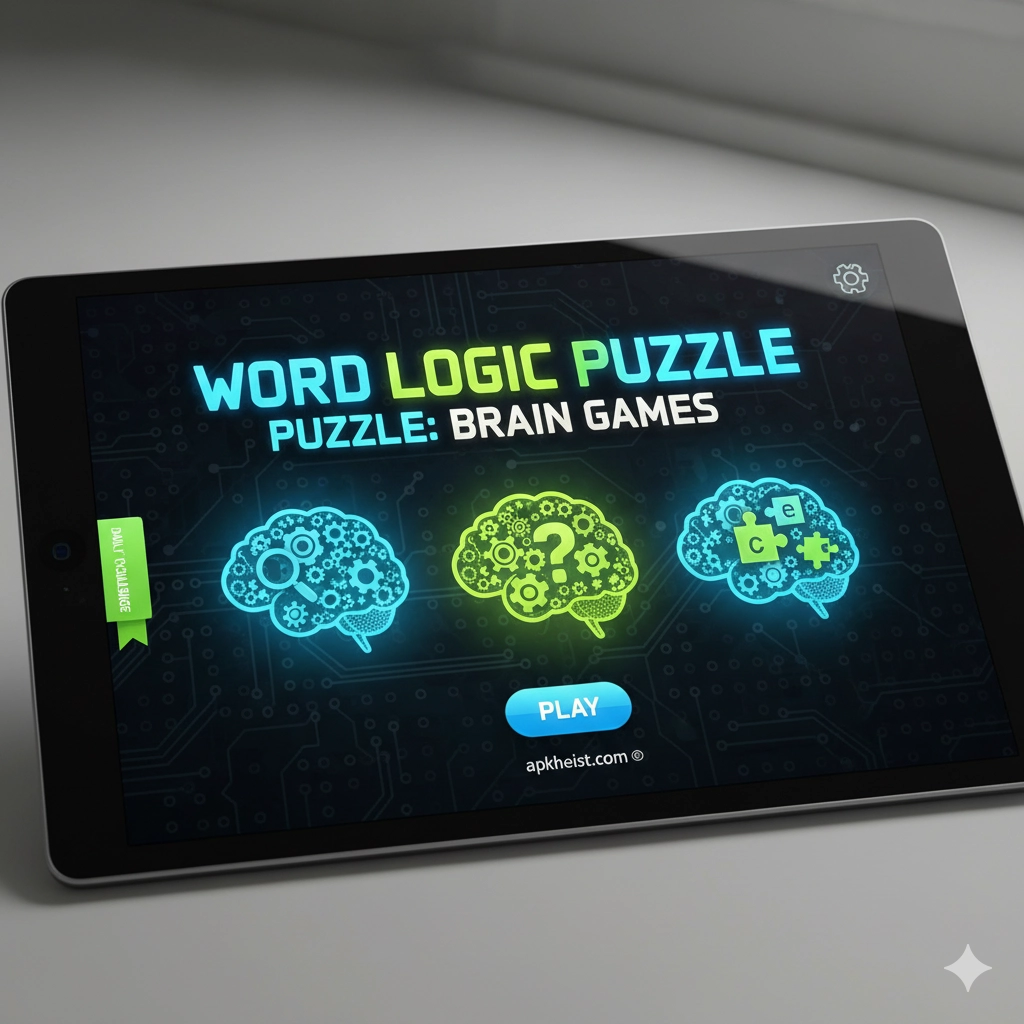
In the evolving world of brain-training entertainment, Word Logic Puzzle: Brain Games stands out by merging linguistic intelligence with analytical thinking. Unlike traditional word searches or crossword puzzles, this format challenges players to identify patterns, decode clues, and organize words using deductive reasoning. Every level becomes a cognitive exercise that strengthens memory retention, critical thinking, and vocabulary expansion. Whether you are a casual gamer exploring the Word category or a dedicated fan of the Puzzle genre, this game offers structured difficulty progression and immersive engagement that keeps your brain actively learning while playing.
Table of Contents
1. Core Gameplay Mechanics – Understanding how logical word construction works.
2. Cognitive Benefits of Word Logic Games – How this format enhances mental agility.
3. Difficulty Scaling and Progression – From beginner grids to expert logic matrices.
4. Strategic Approaches to Solving Puzzles – Techniques for improving accuracy and speed.
5. Why Word Logic Puzzle Appeals to Modern Gamers – The psychology behind its popularity.
6. Comparison with Other Brain Game Genres – Positioning within logic and educational games.
1. Core Gameplay Mechanics
Word Logic Puzzle: Brain Games operates on structured deduction systems. Players are presented with partial word grids, categorized clues, or relational hints that require cross-analysis. Instead of randomly guessing letters, players must identify consistent patterns between rows and columns, eliminate contradictions, and validate solutions through reasoning. This transforms the experience from simple vocabulary recall into a structured logic exercise. The game frequently incorporates constraints such as limited moves, timed sessions, or thematic word groups to increase complexity and reinforce analytical discipline.
2. Cognitive Benefits of Word Logic Games
Engaging in word logic challenges activates multiple cognitive domains simultaneously. Linguistic processing works alongside executive functioning and working memory. Studies on logic-based brain activities suggest improvements in pattern recognition, sustained attention, and cognitive flexibility. By solving progressively difficult word matrices, players strengthen neural pathways associated with reasoning and semantic recall. Over time, this contributes to sharper mental processing and improved decision-making speed, making the game both recreational and intellectually beneficial.
3. Difficulty Scaling and Progression
The structured progression system ensures accessibility for newcomers while maintaining complexity for advanced players. Early stages focus on simple associations and small grids. As levels increase, puzzles introduce multi-layer dependencies, indirect clues, and deceptive distractors. This controlled escalation maintains engagement without overwhelming the player. The game design emphasizes adaptive challenge, which is a core principle in educational game development and cognitive training applications.

4. Strategic Approaches to Solving Puzzles
Successful players apply systematic deduction techniques. One effective approach is elimination mapping—identifying impossible word placements to narrow viable options. Another method is anchor-word identification, where certain clues provide definitive placements that unlock secondary patterns. Time management is equally important in advanced levels. Maintaining logical consistency while avoiding impulsive guessing ensures higher completion accuracy. Developing these structured strategies transforms casual gameplay into disciplined mental training.
5. Why Word Logic Puzzle Appeals to Modern Gamers
Modern audiences seek entertainment that provides value beyond passive consumption. Word Logic Puzzle satisfies this demand by combining enjoyment with measurable cognitive engagement. It fits seamlessly into short play sessions while delivering meaningful mental stimulation. Its alignment with the Educational and Trivia segments broadens its appeal across age groups. The clean interface, structured objectives, and sense of accomplishment after solving complex puzzles contribute to its sustained popularity.
6. Comparison with Other Brain Game Genres
Within the broader landscape of cognitive games, Word Logic Puzzle distinguishes itself by prioritizing deductive structure over reflex-based mechanics. Unlike fast-paced Action titles or chance-driven formats, it demands analytical patience. Compared to pure vocabulary drills, it integrates logical architecture similar to classic grid-based reasoning challenges. This hybridization of wordplay and logical deduction positions it uniquely in the cognitive gaming ecosystem, offering both intellectual depth and accessible entertainment.
Frequently Asked Questions (FAQ)
1. What makes Word Logic Puzzle: Brain Games different from traditional word searches?
Traditional word searches rely primarily on scanning ability and vocabulary familiarity. Word Logic Puzzle integrates structured deduction systems, requiring players to analyze relationships between clues and word placements rather than simply locating hidden terms.
2. Is Word Logic Puzzle suitable for all age groups?
Yes. The adjustable difficulty levels make it appropriate for students, adults, and even seniors seeking cognitive stimulation. The progression system ensures gradual skill development.
3. Does playing word logic games improve memory?
Regular engagement can enhance working memory and semantic recall by repeatedly activating neural circuits involved in language processing and logical reasoning.
4. How often should I play to see cognitive benefits?
Consistent short sessions—around 10 to 20 minutes daily—are generally effective for maintaining cognitive sharpness without mental fatigue.
5. Are there competitive elements in Word Logic Puzzle: Brain Games?
Many versions incorporate leaderboards, timed challenges, or achievement systems, adding motivational incentives while preserving the core logical framework.
6. Can beginners easily adapt to advanced levels?
Yes. The gradual introduction of complexity ensures that players build foundational deduction skills before encountering multi-variable logic matrices.
7. Why are word logic games considered brain training tools?
Because they simultaneously engage language comprehension, analytical reasoning, and memory systems. This multi-domain activation supports cognitive resilience and mental agility over time.