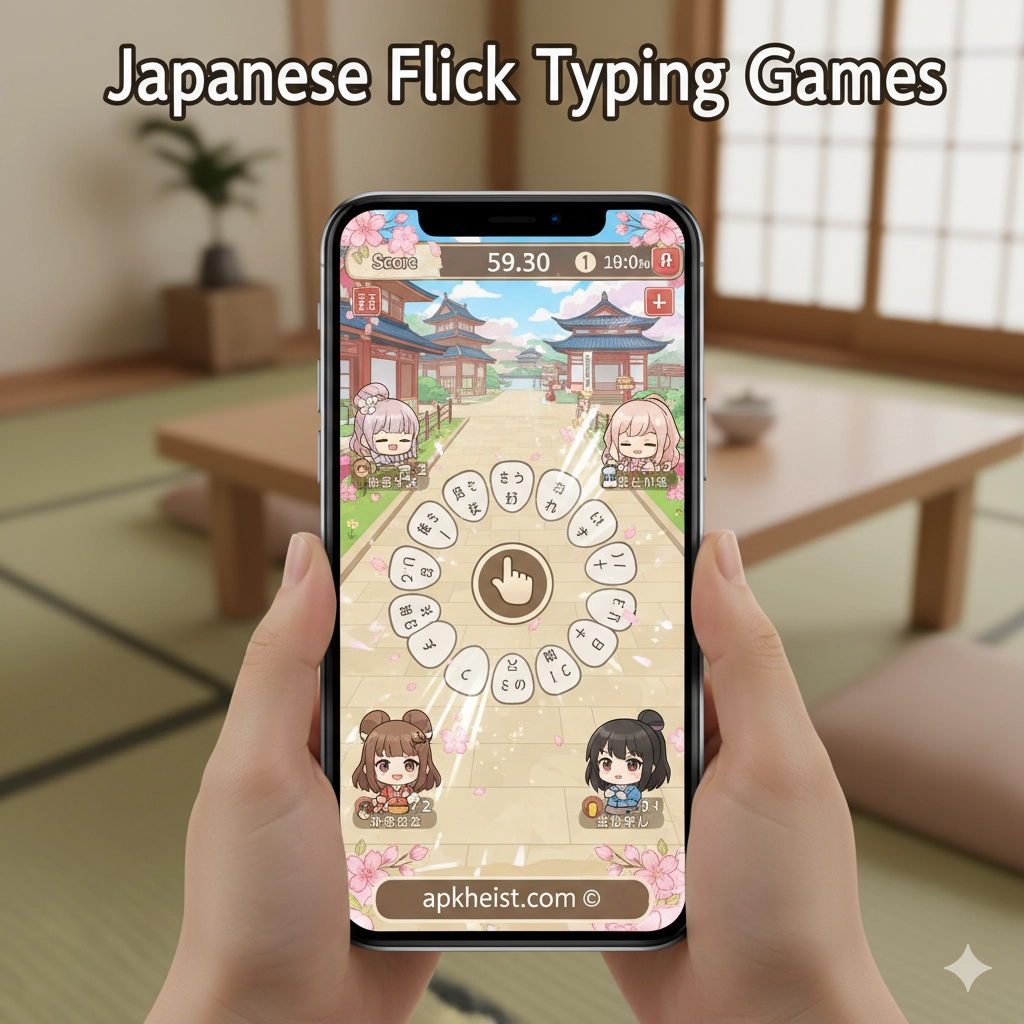
Unlike traditional typing tutors, Japanese Flick Typing app Games focus on the native smartphone input method widely used in Japan. Instead of tapping individual letters, players flick characters in different directions to produce hiragana and katakana efficiently. These games transform repetitive drills into competitive score-based challenges, time attacks, multiplayer battles, and vocabulary missions. Whether you are a beginner memorizing the gojūon table or an advanced learner optimizing typing speed for real-world messaging, flick typing games provide measurable progress, muscle memory development, and gamified motivation.
Guess The Pictures Games: The Ultimate
Explore the Core Features of Japanese Flick Typing App Games
1. Realistic Kana Keyboard Simulation – Authentic 12-key layout practice with directional flick accuracy tracking.
2. Speed Challenge and Time Attack Modes – Competitive gameplay designed to improve reaction time and fluency.
3. Vocabulary Expansion Missions – Integrated word lists that reinforce reading comprehension.
4. Multiplayer Ranking and Leaderboards – Global score comparisons for continuous motivation.
5. Adaptive Difficulty Systems – Intelligent progression based on typing performance analytics.
1. Realistic Kana Keyboard Simulation
At the foundation of Japanese Flick Typing app Games is the accurate replication of Japan’s standard mobile 12-key kana keyboard. Each key contains multiple syllables arranged directionally: tap for the base kana, then flick up, down, left, or right for variations. High-quality apps analyze gesture angle, input latency, and correction frequency to provide feedback on precision. This system builds procedural memory, which is essential for real-life texting efficiency. Over time, learners transition from conscious recall of kana placement to automatic execution, significantly increasing words-per-minute output while reducing cognitive load.
2. Speed Challenge and Time Attack Modes
Speed-based modes introduce controlled pressure to enhance reflexes and kana recall speed. Players are typically given 30–120 seconds to input as many correct characters or words as possible. Performance metrics include accuracy rate, combo streaks, and average input time per kana. Competitive formats mirror arcade-style mechanics similar to fast-response titles in the Arcade category, making language acquisition dynamic rather than passive. Regular engagement in time attack modes significantly reduces hesitation between flick gestures.
3. Vocabulary Expansion Missions
Beyond mechanical input, advanced Japanese Flick Typing app Games incorporate structured vocabulary modules. These may include everyday phrases, JLPT-level word sets, or thematic lessons such as travel, business, and pop culture. By embedding vocabulary into gameplay loops, players simultaneously reinforce orthographic recognition and semantic understanding. Some apps even gamify sentence construction, blending mechanics commonly found in Educational apps with reflex-driven gameplay.

4. Multiplayer Ranking and Leaderboards
Social competitiveness drives retention. Many Japanese Flick Typing app Games feature online leaderboards, weekly tournaments, and friend-versus-friend battles. Ranking algorithms often weigh both speed and accuracy to prevent careless spamming. Competitive dynamics resemble score systems seen in 5th Grader Quiz: Are You Smart Games, where cognitive performance directly impacts leaderboard status. This structure encourages consistent practice and long-term skill refinement.
5. Adaptive Difficulty Systems
Modern apps deploy adaptive learning frameworks that analyze error frequency per kana, hesitation duration, and correction patterns. Based on these metrics, the system increases complexity by introducing compound words, long vowel combinations, small tsu (っ), and katakana loanwords. Such personalization ensures learners remain within an optimal challenge zone—neither bored nor overwhelmed. Over extended usage, this leads to exponential gains in both speed and retention.
Frequently Asked Questions about Japanese Flick Typing App Games
1. Are Japanese Flick Typing app Games suitable for complete beginners?
Yes. Most apps begin with kana chart tutorials and guided drills. Beginners can start with slow-paced lessons before progressing to competitive modes.
2. How long does it take to see improvement in flick typing speed?
With daily 10–15 minute sessions, measurable improvements often appear within two to three weeks, particularly in reaction time and gesture confidence.
3. Do these games help with JLPT preparation?
Indirectly, yes. While they focus on input speed, vocabulary modules and kana fluency significantly support reading sections of JLPT exams.
4. Is flick typing better than QWERTY input for Japanese?
For mobile devices in Japan, flick input is generally faster and more space-efficient. Mastery aligns with real-world texting norms.
5. Can advanced learners benefit from Japanese Flick Typing app Games?
Absolutely. Advanced players refine micro-efficiency, reduce typo rates, and enhance natural messaging flow, particularly when handling complex katakana terms and long compound expressions.
Japanese Flick Typing app Games transform language mechanics into engaging, performance-driven challenges. By integrating realistic keyboard simulation, adaptive algorithms, and competitive frameworks, these apps provide a structured yet entertaining pathway to mastering Japanese mobile input.