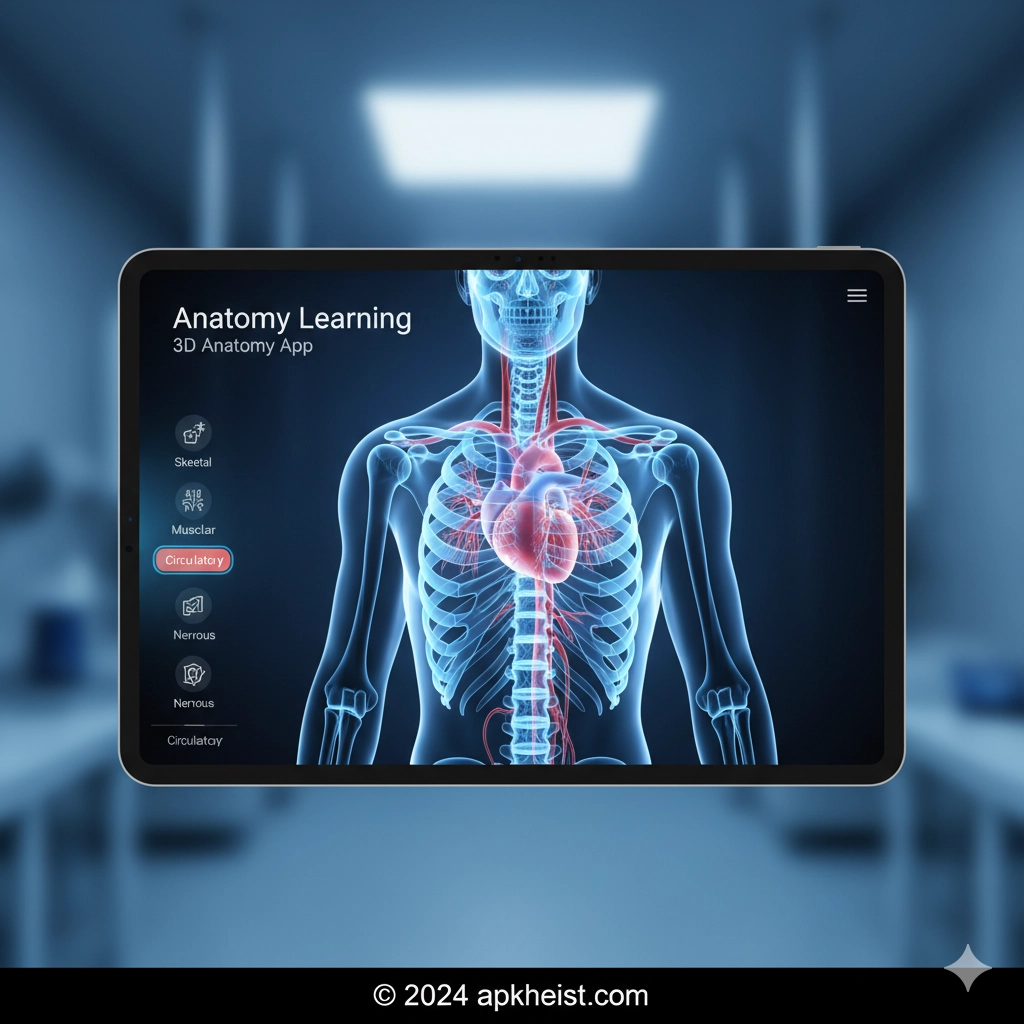
Big Introduction: In modern digital education, understanding human anatomy requires more than static diagrams. Anatomy Learning - 3D Anatomy App provides a dynamic, immersive experience where learners can rotate, dissect, and analyze anatomical structures in real time. It is widely used by medical students, healthcare professionals, and biology enthusiasts to strengthen conceptual understanding through visual and interactive learning. The platform bridges theoretical knowledge with practical visualization, making complex biological systems easier to comprehend and memorize.
Section Overview: This article breaks down the core functionalities, learning modules, and educational advantages of Anatomy Learning - 3D Anatomy App through structured sections covering anatomy systems, visualization technology, and real-world use cases.
Digitale Hausapotheke App: Smart Digital
Qwili App – A Digital Commerce Infrastru
SAMSUNG RETAILMODE App: Intelligent In
Navigation Index
1. Core App Architecture Overview
4. Muscular System Learning Module
6. Interactive Quizzes & Learning Tools
7. Medical Education Applications
1. Core App Architecture Overview
Anatomy Learning - 3D Anatomy App is built on a modular educational framework that integrates anatomical datasets with real-time rendering engines. The system organizes human anatomy into layered structures, allowing users to toggle between systems such as skeletal, muscular, circulatory, and nervous systems. Each module is designed for scalability, enabling learners to progressively unlock deeper anatomical complexity. The architecture supports both guided learning and free exploration modes, making it suitable for structured academic curricula as well as independent study.
FaceTec Demo App: How Advanced 3D Fac
2. 3D Visualization Engine
The core strength of Anatomy Learning - 3D Anatomy App lies in its advanced 3D visualization engine. It renders anatomically accurate models with high fidelity, enabling users to zoom, rotate, and isolate structures in real time. The rendering pipeline supports layered transparency, allowing users to peel back skin, muscle, and connective tissue to observe underlying systems. This interactive visualization enhances spatial understanding, which is critical for medical training and surgical preparation.
3. Skeletal System Deep Dive
The skeletal module provides a complete breakdown of the human bone structure, including axial and appendicular skeletons. Users can explore individual bones, study articulation points, and understand biomechanical relationships between joints. The app highlights anatomical landmarks and provides contextual labeling, making it easier to memorize complex bone structures. This system is particularly valuable for orthopedic learning and radiology reference.
4. Muscular System Learning Module
The muscular system section offers detailed visualization of muscle groups, fiber orientation, and functional movement patterns. Users can simulate muscle contractions and observe how different muscle groups interact during motion. This helps in understanding biomechanics, physical therapy principles, and athletic performance optimization. The app also includes origin and insertion points for each muscle, enhancing anatomical precision.
Smart Mobile Switch PhoneClone App: T

5. Nervous System Mapping
The nervous system module visualizes the central and peripheral nervous systems in intricate detail. It maps neural pathways, brain regions, and spinal cord structures with interactive overlays. Users can trace signal transmission routes and understand functional connectivity between different parts of the nervous system. This is especially useful for neurology students and cognitive science learners.
6. Interactive Quizzes & Learning Tools
Anatomy Learning - 3D Anatomy App includes integrated quizzes, labeling challenges, and adaptive learning tools that reinforce retention. The system uses spaced repetition techniques to improve long-term memory of anatomical structures. Users can test themselves on system identification, structure naming, and functional relationships, making learning both active and measurable.
IGAMES PS2 App: Next-Gen Retro Gaming
7. Medical Education Applications
The app is widely used in medical schools, nursing programs, and physiotherapy training. It serves as a supplementary tool for cadaver labs and traditional anatomy textbooks. By providing repeatable and interactive visualization, it reduces dependency on physical specimens while increasing accessibility for remote learners. Its practical applications extend to patient education, where clinicians can visually explain conditions using 3D anatomical models.
FAQ 1: What is Anatomy Learning - 3D Anatomy App?
It is a digital medical education platform that provides interactive 3D visualization of human anatomy for students, professionals, and self-learners.
FAQ 2: Is the app suitable for beginners?
Yes, it is designed with layered learning modes that allow beginners to start with basic anatomical structures and gradually progress to advanced systems.
FAQ 3: Does it require an internet connection?
Some features may work offline, but full access to updates, models, and cloud-based content typically requires internet connectivity.
FAQ 4: How accurate are the 3D models?
The models are built using medically validated anatomical datasets, ensuring high accuracy suitable for academic and clinical reference use.
FAQ 5: Can it replace traditional anatomy textbooks?
It is not a full replacement but a powerful supplementary tool that enhances understanding through interactive visualization.
FAQ 6: Which devices support the app?
The app is generally supported on modern Android and iOS devices with sufficient GPU performance for 3D rendering.
FAQ 7: Is it used in professional medical training?
Yes, it is commonly used in medical schools and clinical training environments to support anatomy education and patient communication.